
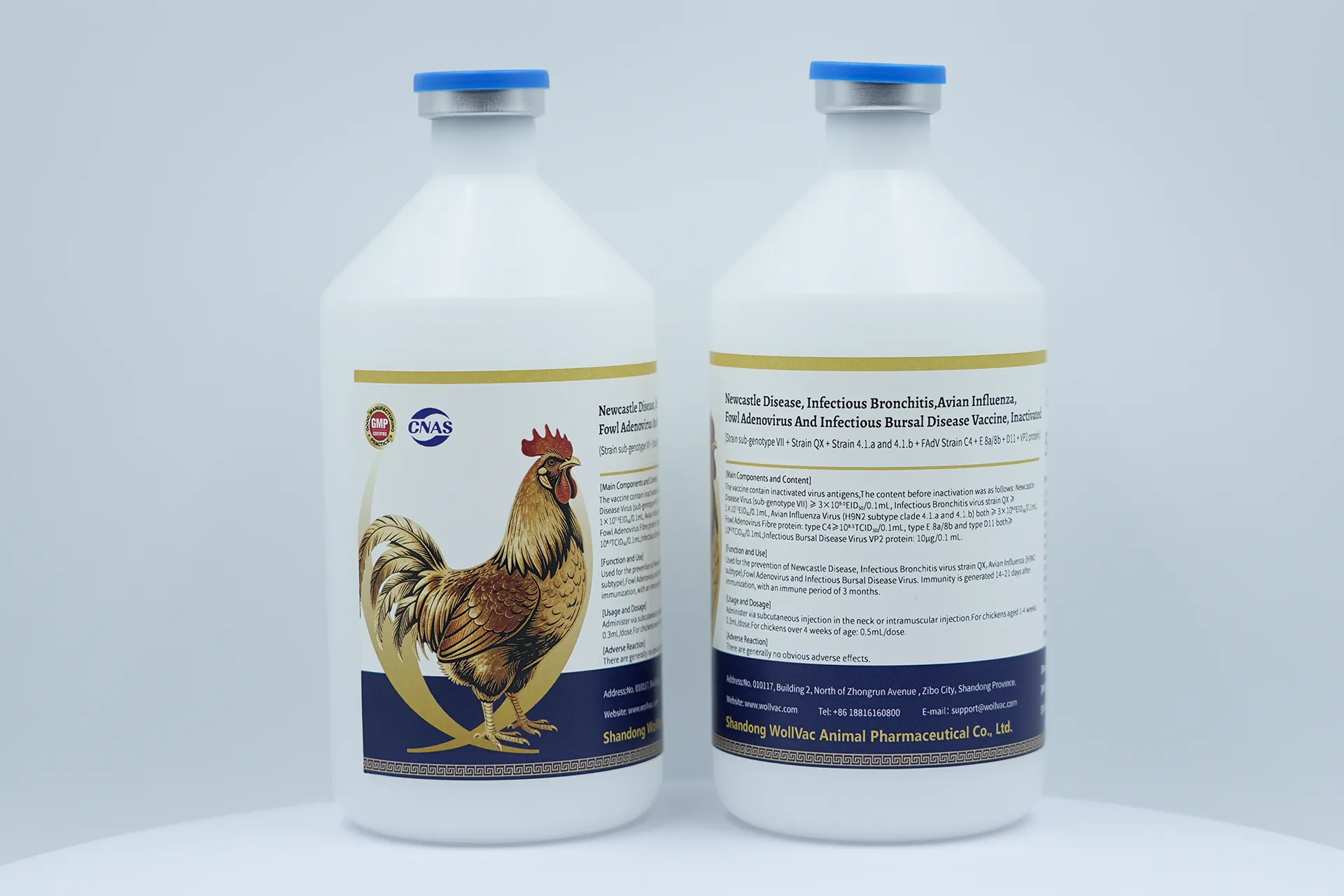
Newcastle Disease, Infectious Bronchitis,Avian Influenza (Subtype H9) , Fowl Adenovirus And Infectious Bursal Disease Five-valent Vaccine, Inactivated
- Indication / Application:Prevention of Newcastle Disease(sub-genotype VII), Infectious Bronchitis virus strain QX,Avian Influenza (H9N2 subtype clade 4.1.a and 4.1.b),Fowl Adenovirus and Infectious Bursal Disease Virus.
- Manufacturing: Produced in GMP-certified facility
- Supply Mode: Bulk Supply / Distributor / OEM Available
- Origin: China
Generic name of product
Newcastle Disease, Infectious Bronchitis,Avian Influenza (Subtype H9) , Fowl Adenovirus And Infectious Bursal Disease Five-valent Vaccine, Inactivated
Main Ingredients And Content
The vaccine contain inactivated virus antigens,The content before inactivation was as follows: Newcastle Disease Virus (sub-genotype VII) ≥ 3×109.0EID50/0.1mL, Infectious Bronchitis virus strain QX ≥ 1×107.5EID50/0.1mL, Avian Influenza Virus (H9N2 subtype clade 4.1.a and 4.1.b) both ≥ 3×109.0EID50/0.1mL; Fowl Adenovirus Fibre protein: type C4≥108.5TCID50/0.1ml, type E 8a/8b and type D11 both≥108.0TCID50/0.1ml;Infectious Bursal Disease Virus VP2 protein: 10μg/0.1 mL.
Character
Milky white uniform emulsion
Function And Purpose
Indications: Prevention of Newcastle Disease(sub-genotype VII), Infectious Bronchitis virus strain QX,Avian Influenza (H9N2 subtype clade 4.1.a and 4.1.b),Fowl Adenovirus and Infectious Bursal Disease Virus. Immunity is generated 14–21 days after immunization, with an immune period of 3 months.
Usage And Dosage
Administer via subcutaneous injection in the neck or intramuscular injection.
For chickens aged 1-4 weeks: 0.3ml/dose
For chickens over 4 weeks of age: 0.5ml/dose
Adverse Reactions
Generally, there are no obvious adverse reactions.
Precautions
- 1. Inoculate healthy chickens only. It is forbidden to use in emaciated and diseased chickens.
- 2. Check carefully for broken bottles, absent label, impurity in vaccine, severe separation of water phase and oil phase, and other abnormal conditions before use, if any, do not use.
- 3. Allow the vaccine to room temperature and shake well before use.
- 4. After the vaccine bottle is first opened, use up the vaccine within 2 hours, avoiding contamination.
- 5. The vaccine shouldn’t be frozen.
- 6. Instruments such as the needles and syringes for the injection of the product need to be disinfected by pressured steam or boiling.
- 7. The vaccine should be combined with live Newcastle disease and infectious bronchitis vaccines to improve cell-mediated immunity and mucosal immunity.
Storage and Period of Validity
2-8℃ preservation, valid for 24 months.
Specifications
(1)250mL/bottle, 40bottles/carton (2)500mL/bottle, 20bottles/carton
Only under the guidance of the veterinary use
Due to significant variations in the prevalent H5 avian influenza strains across different regions, we can adjust the H5 and H9 Avian Influenza antigen combinations according to customer requirements to achieve optimal disease prevention effects.
H5 subtype clades: 2.3.2.1b/2.3.2.1e/2.3.4.4b/2.3.4.4c/2.3.4.4e/2.3.4.4h
H9N2 subtype clade 4.1.a and 4.1.b or 4.2.5.
Features
- After a decade of R&D, WollVac’s latest product makes its grand launch in 2025. Offering "one injection for five protections," it enhances epidemic prevention efficiency and effectiveness.
- Featuring carefully selected strains and viral composite subunit antigens, this innovative solution is a pioneering breakthrough in China. Formulated with a composite adjuvant, it leverages the advantages of compound vegetable oil to ensure zero stress on animals.
The use of complex antigens:
Serotype matching is essential for effective vaccine protection. Using real-time data from the Shandong Provincial Engineering Laboratory for Animal Pathogenic Microorganisms Testing Center, the R&D Center evaluates prevalent strains from the epidemic pathogen bank through multiple stages—preliminary lab screening, animal testing, and cross-protective antibody assessment. The selected dominant strains ensure broad and high-efficacy protection.
| Antigen | ND | IB | AI H9N2 | FADV | IBDV |
|---|---|---|---|---|---|
| Strain | VII type | QX |
h 9.4.1.a + h 9.4.1.b h 9.4.2.5b + h 9.4.2.5c |
C4 + E8b + D11 | cvvIBDV + nvIBDV |